
Motorhome 12 V system: batteries, distribution, fuses, energy budget
⚠️ Safety: 230 V wiring must be installed and tested by a qualified electrician (IEC/HD 60364-7-721). At 12 V the main hazard is fire from a short circuit – fuse every (+) cable at its source. Disconnect the batteries before working.
The 12 V system in the living area powers lighting, the water pump, a compressor fridge, heater fans, the control panel and USB sockets. It is covered by EN 1648-2 (motorhomes) and EN 1648-1 (caravans). Appliances must work across 11–15 V, the leisure battery must be at least 60 Ah (20-hour rate), and the habitation circuit must disconnect automatically from the base vehicle when the engine is off. Charging is covered in charging: alternator, solar, charger, and mains power in 230 V system.
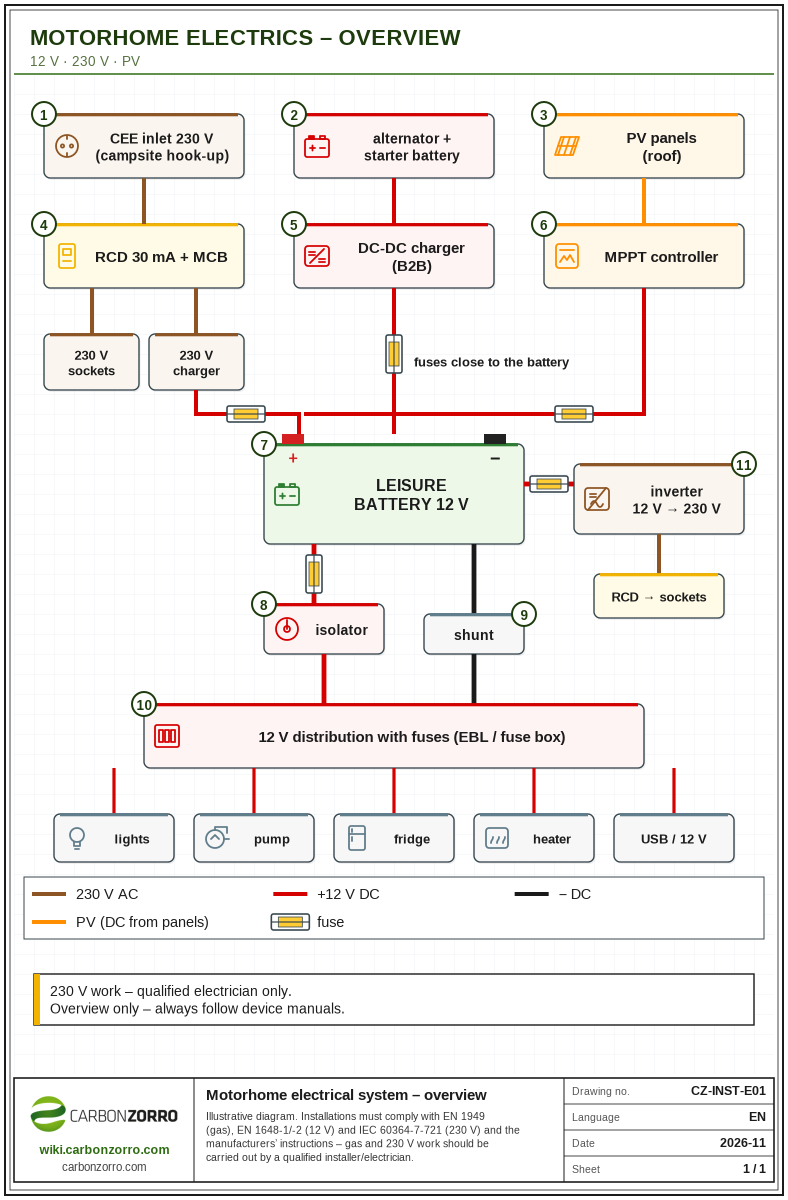
What the 12 V system is made of
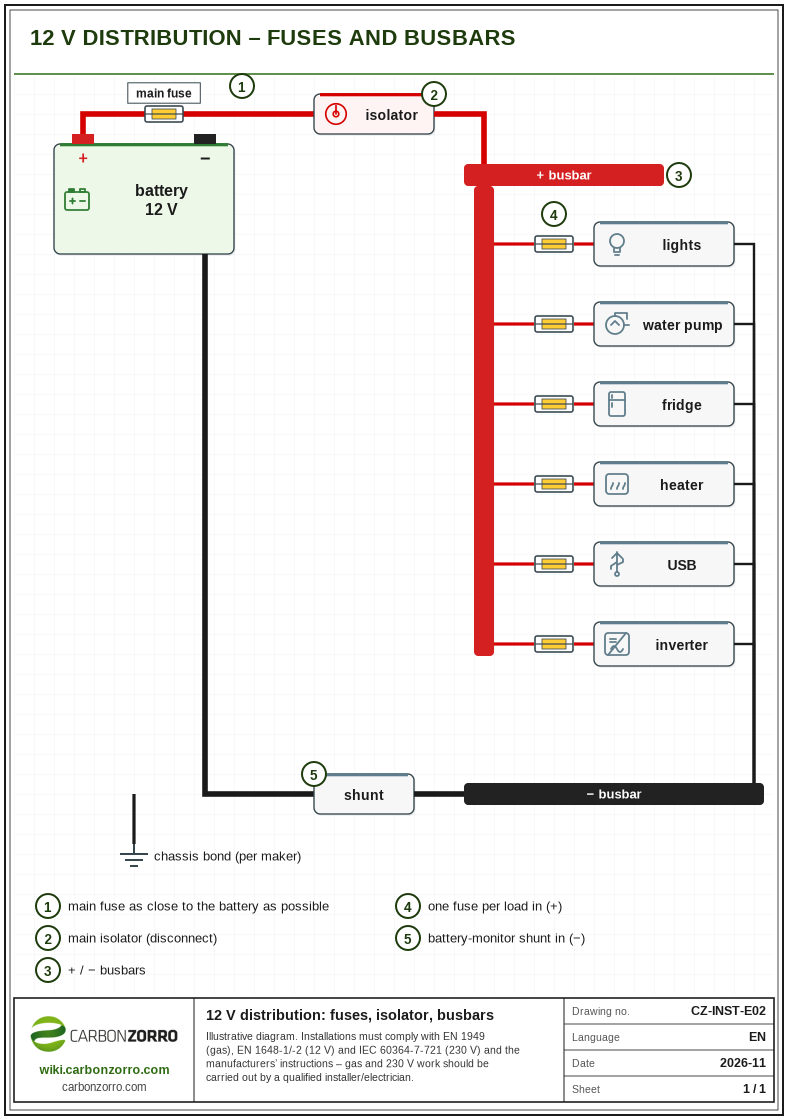
| Part | Purpose | Notes |
|---|---|---|
| Leisure battery | energy storage | AGM/gel or LiFePO4; EN 1648-2: at least 60 Ah (20 h) |
| Main fuse at the battery | protects the (+) cable from fire | type and rating per cable size; for LiFePO4 with sufficient interrupt rating (Victron) |
| Battery isolator | disconnects everything | rating ≥ main current |
| Busbars (+/−) | distribution | equal path lengths to parallel batteries (Victron) |
| Shunt / battery monitor | Ah and state of charge | in the (−) cable; every load and charger connected after the shunt |
| Distribution unit with fuses (EBL) | load circuits | fuses to ISO 8820 (EN 1648-2) |
| Control panel | voltage, tank levels | e.g. CBE PC systems |
| Loads | lights, pump, fridge… | every (+) circuit fused |
🛒 Products in the carbonzorro.com shop
- CBE DS300 - 12 V distribution box, for PC100 and PC200
- CBE PC380 - complete digital 12 V system, black
- CBE PC210 - kompletny system 12 V, czarny (Polish product page)
- MEGA-fuse 150A/32V (package of 5 pcs)
- MIDI-fuse 60A/32V (package of 5 pcs)
- ANL-fuse 300A/80V for 48V products (1 pc)
- Carbest power distributor with 12 fuse holders - up to 32 V, 30 A per circuit, LED
- Unival 6-way fuse box with fuses
- Busbar Solvian 150A 6P M6
- Busbar Solvian 150A 12P M4 + konektory (Polish product page)
- Rozłącznik akumulatora Solvian 12/24V 250A ON-OFF
- Dimatec battery disconnect switch 100 A 32 V, single pole, red, 45 mm - for motorhome and boat
Batteries – AGM vs LiFePO4
| Property | AGM (e.g. Victron AGM Super Cycle) | LiFePO4 (e.g. Victron Lithium Smart) |
|---|---|---|
| Absorption voltage | 14.2–14.6 V | 14.2 V (2 h) |
| Float voltage | 13.5–13.8 V | 13.5 V |
| Charge current | per manufacturer | 0.5 C recommended |
| Charging temperature | per manufacturer | +5…+50 °C |
| Discharging temperature | per manufacturer | −20…+50 °C |
| Capacity in the cold | per manufacturer | −20 % at 0 °C, −50 % at −20 °C |
| Temperature-compensated charging | per manufacturer | do not use (Victron) |
| Watch out | vent the box (flooded lead-acid), tray | after BMS low-voltage cut-off, a 10 mA drain can ruin a 200 Ah battery in 8 days |
Figures for a specific model are in the maker's datasheet. Every charger, booster and solar controller must use a profile that matches the battery chemistry.
LiFePO4 in winter: charge only above +5 °C (Victron). Batteries with a heating pad or "Arctic" versions are installed in the heated part of the vehicle.
🛒 Products in the carbonzorro.com shop
- 100 Ah ULTIMATRON akumulator LiFePO4 Smart BMS 12.8V (Polish product page)
- 100Ah Under Seat ULTIMATRON Lithium Battery 12,8V with Heating
- LIONTRON LiFePO4 12.8V 150Ah LX Smart w. Bluetooth Arctic under seat
- LIONTRON LiFePO4 12.8V 200Ah LX Smart w. Bluetooth Arctic
- 200Ah battery ULTIMATRON LiFePO4 Smart BMS 12.8V
- Lithium Battery LiFePO₄ tHE Bat 150, 12.8 V, 150 Ah
- AGM Battery Dual Purpose
- 120Ah Lead-acid Battery ENERBLOCK JDP AGM DuoPower 12.8V
- 150AH Battery JDG-AGM-GEL Hybrid ENERBLOCK 12V
Batteries in parallel and in series
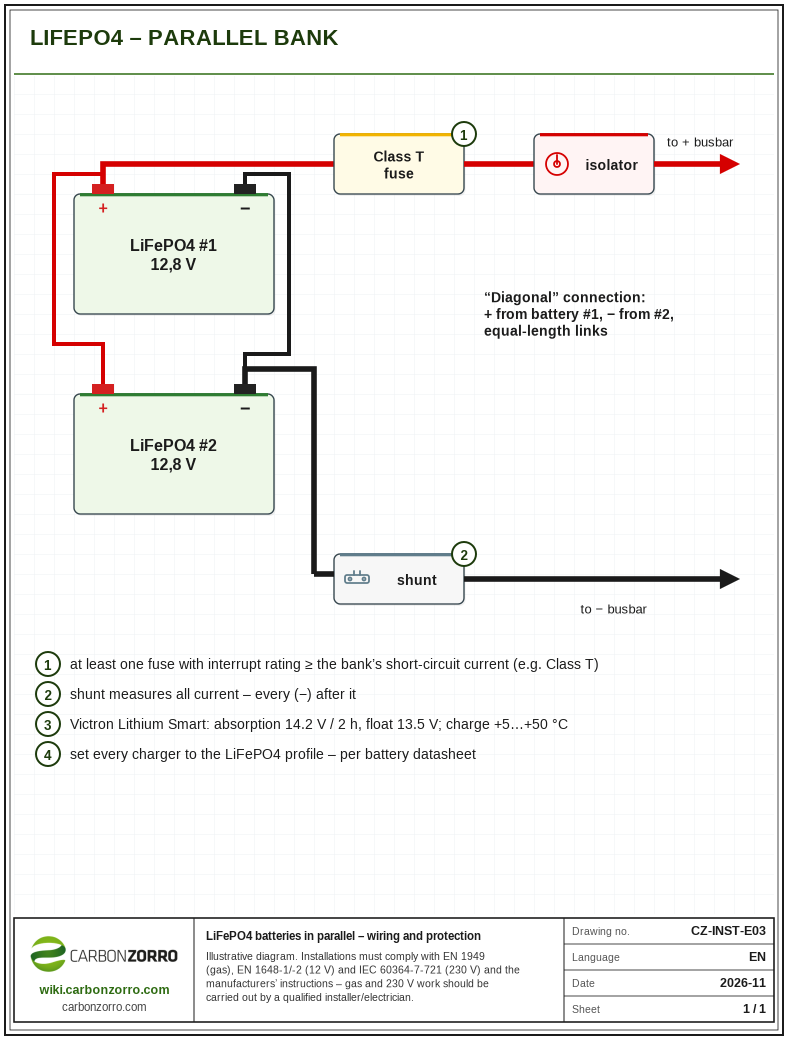
Victron's "Wiring Unlimited" says that in a parallel bank each battery must see the same total current path. Busbars with cables of equal length work best. Diagonal connection (+ from the first battery, − from the last) is simple but not perfect. A series string needs a battery balancer. Only combine batteries of the same type, capacity and age. With LiFePO4, follow the maker's manual, because not every BMS allows series connection or an unlimited number of batteries in parallel.
Battery compartment – EN 1648-2
- Vented (flooded) batteries: vents of 80 mm² at the bottom and the top of the compartment, and a tray holding ≥ 20 % of the electrolyte volume.
- A warning notice and the ISO 7010-P003 no-open-flame sign.
- Battery firmly secured, terminals covered.
- Fuse the (+) conductor as close to the battery as possible (EN 1648-2, clause 6.1 – the exact distance is in the full text of the standard).
- LiFePO4: location and ventilation per the manufacturer.
Energy budget – sizing the battery
Work out the daily consumption: current of each load × hours of use = Ah per day. Take the currents from the appliance manuals. Examples from manufacturer data:
| Load | Current at 12 V (manufacturer) | Example hours / day (assumption) | Ah / day |
|---|---|---|---|
| Truma Combi 4 (fan, electronics) | average 1.2 A | 10 h | 12 |
| Fiamma Aqua 8 pump (7 l/min) | 1.4–2.7 A | 0.3 h | approx. 0.8 |
| Dometic RML 10.4 absorption fridge on 12 V | 14.2 A | only while driving | – |
| Combi 4 – standby | 1 mA | 24 h | 0.02 |
The hours are example assumptions, so replace them with your own and add a margin to the total. AGM batteries give you only part of their rated capacity, LiFePO4 a larger share; check the recommended depth of discharge in the datasheet.
An absorption fridge on 12 V draws a lot of current (14.2 A for the RML 10.4). When parked it runs on gas or 230 V, and it normally uses 12 V only while driving, fed from the alternator via a D+ relay.
🛒 Products in the carbonzorro.com shop
Installation sequence
- Plan: list of loads, currents, cable lengths and cross-sections (see cable and fuse tables).
- Disconnect the starter and leisure batteries, (−) first.
- Mount the battery or batteries, isolator, main fuse, busbars and shunt.
- Main cables: crimped ring terminals matched to the cable size; terminal covers.
- Distribution: every circuit fused to suit its cable; label the circuits.
- Routing: away from sharp edges and heat, in conduit or sleeving; rubber grommets at pass-throughs.
- Connect the battery (+) first, (−) last. Check the voltage and test every circuit.
- Set the charge profile on every charger to match the battery chemistry.
🛒 Products in the carbonzorro.com shop
- Menbaa ELFLEX Battery Cable 25 mm², Red, 10 m - For Batteries, Inverters and Chargers
- Menbaa kabel akumulatorowy ELFLEX 35 mm², czarny, 10 m - do akumulatorów, przetwornic i ładowarek (Polish product page)
- Menbaa Crimp Ring Terminals M8, 16 to 25 mm², Non-Insulated, 10 Pieces - For Battery Cables
- Końcówka kablowa oczkowa Ø 8 mm na przewód 16 mm² - zaciskana, do instalacji 12 V w kamperze (Polish product page)
Troubleshooting
| Symptom | Cause | Fix |
|---|---|---|
| Voltage dips when the pump starts | cable too thin, loose terminal | measure the voltage drop, tighten, upsize the cable |
| LiFePO4 will not accept charge | BMS blocks charging below +5 °C | warm the battery, fit a heating pad |
| Battery flat after being parked | standby currents | battery isolator, measure the quiescent current |
| Fuse keeps blowing | short circuit or overload | find the cause; never fit a bigger fuse |
| Monitor shows nonsense | load or charger connected before the shunt | route every (−) through the shunt |
12 V checklist
- [ ] main fuse at the battery, sized for the cable
- [ ] every (+) circuit fused
- [ ] cross-sections chosen for current and length (voltage drop)
- [ ] battery secured, terminals covered, box vented (lead-acid)
- [ ] charge profiles match the chemistry
- [ ] battery isolator within reach
- [ ] habitation circuit disconnects from the vehicle when the engine is off (EN 1648-2)
Sources
Every figure on this page comes from the sources below (standards, manufacturer manuals, regulations). Before installing, check the current edition of the standard and the manual of your specific device.
- EN 1648-2:2018 – standard preview
- Victron – Wiring Unlimited: theory (voltage drop)
- Victron Lithium Battery Smart – operation
- Victron – Wiring Unlimited: DC wiring and fuses
- Victron AGM Super Cycle – datasheet
- Victron – Wiring Unlimited: battery bank wiring
- Truma Combi 4 – technical data
- Fiamma Aqua 8 – manual
- Dometic RML 10.4 – technical data
If you spot an inaccuracy, please report it to info@carbonzorro.com.
The content of this Knowledge base is for general information and illustration only. It is not technical or legal advice and does not replace standards, regulations, manufacturers’ instructions or the work of a qualified installer. Carbon Zorro Sp. z o.o. makes every effort to keep the information accurate and up to date, but does not guarantee that it is complete and accepts no liability for any consequences of its use.
Questions & comments