
Motorhome and caravan gas (LPG) system: layout, components, installation
⚠️ Safety: installation, modification and leak testing of an LPG system should be carried out by a qualified installer. This guide explains how systems are built – it does not replace EN 1949, the manufacturer’s instructions or an inspection.
The LPG (propane/butane) system in a motorhome or caravan supplies the heater, water heater, hob and absorption fridge. In Europe these installations are covered by EN 1949 (BS EN 1949 in the UK), and appliances have run at 30 mbar since the mid-1990s (promobil). This chapter follows the gas from cylinder to burner. The gas locker, leak testing and detectors are covered in gas locker and leak testing, and national requirements in country rules.
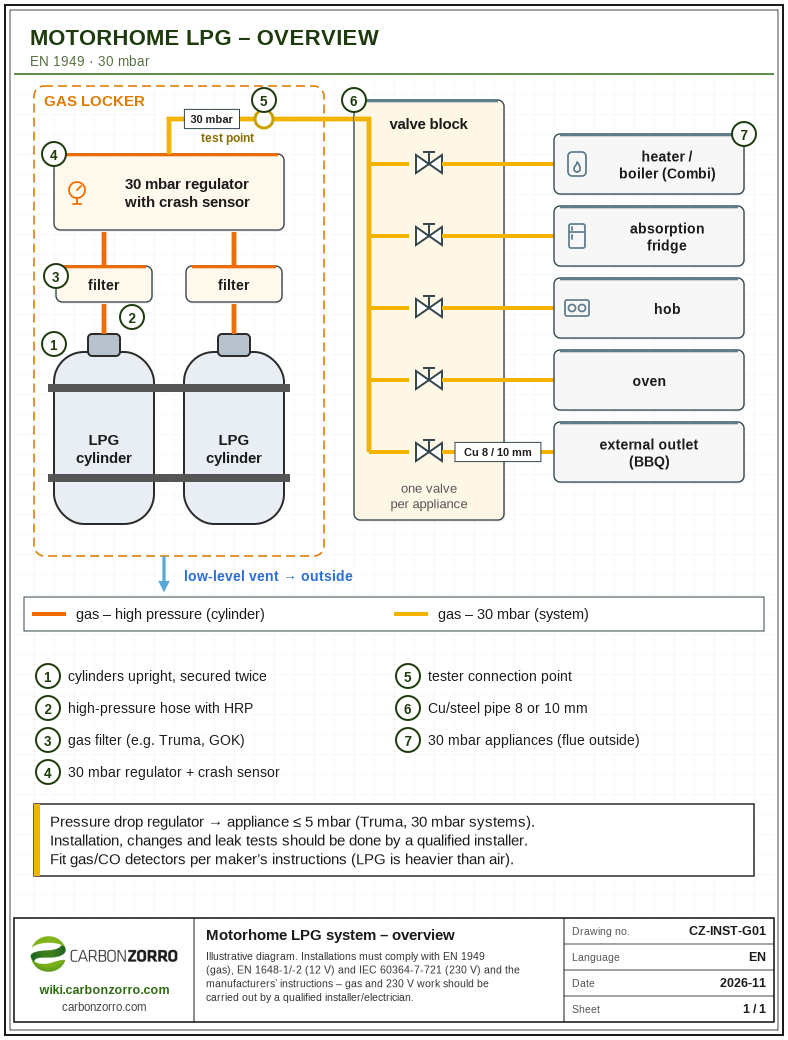
The path from cylinder to appliance
- Cylinder or tank: upright, valve on top, secured at high and low level (EN 1949, 5.1.2.2).
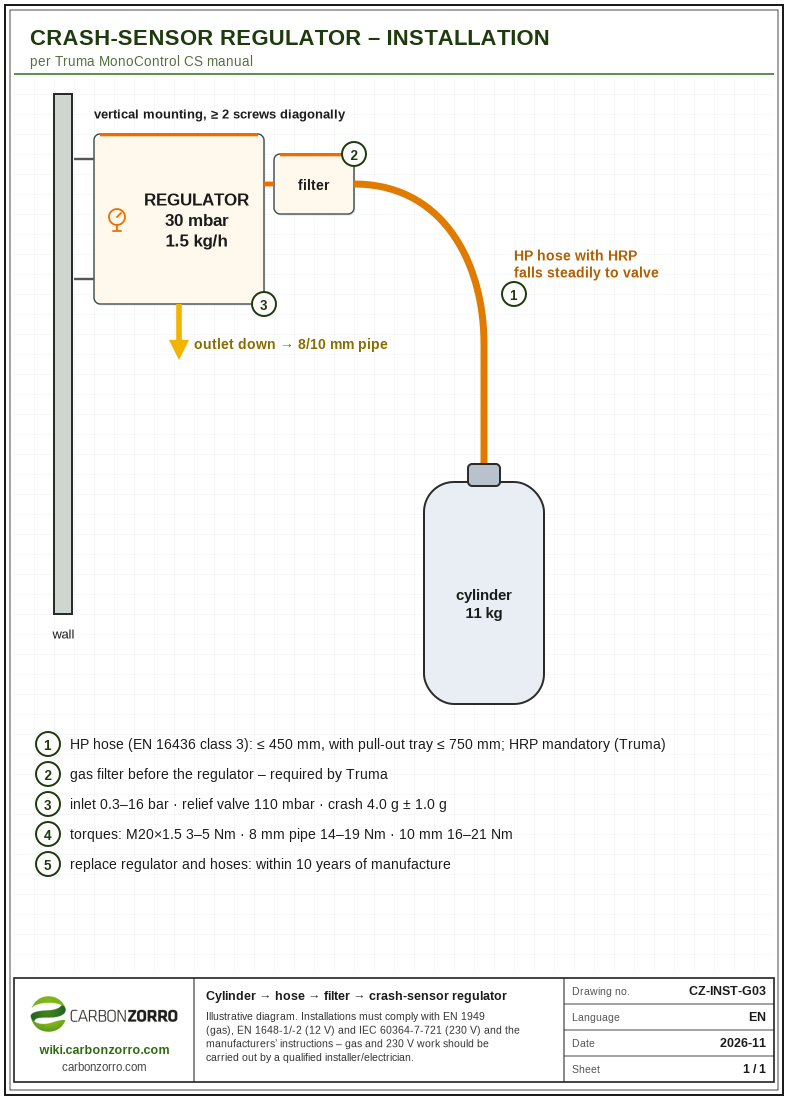
- High-pressure hose from cylinder to regulator: EN 16436 class 3, marked 30 bar (Liquid Gas UK). In Germany G 607 allows a maximum of 45 cm, or 75 cm with a pull-out tray (lpgwebshop). In UK touring caravans the maximum is 0.5 m (BS EN 1949, Liquid Gas UK).
- Hose rupture protection (SBS/HRP): mandatory with the Truma MonoControl CS. promobil states it is required for hoses from 1.5 m and when heating on the move.
- Gas filter upstream of the regulator: Truma requires it for the MonoControl CS, because oily residues in the gas damage the regulator. promobil notes it is also a warranty condition.
- 30 mbar regulator: wall-mounted in the locker, vertical, outlet facing down, fixed with at least 2 diagonal screws. The high-pressure connection sits above the cylinder valve, with the hose falling continuously towards the cylinder (MonoControl CS instructions).
- Low-pressure pipe: usually 8 mm copper or steel, with compression fittings to EN ISO 8434-1. The pressure loss from regulator to appliance must not exceed 5 mbar in 30 mbar systems (Truma). Truma recommends 10 mm pipe for 30 mbar systems fed from tanks.
- Isolating valves: one per appliance, usually in a valve block in the kitchen (EN 1949).
- Appliances: heater, water heater, hob, fridge, and optionally an external gas point for a barbecue.
Components at a glance
| Component | Data / requirement | Source |
|---|---|---|
| Truma MonoControl CS regulator | outlet 30 mbar; inlet 0.3–16 bar; 1.5 kg/h; crash sensor 4.0 g ±1.0 g; relief valve 110 mbar; −20…+50 °C | Truma |
| Regulator connections | inlet M20×1.5; outlet 8 or 10 mm olive | Truma |
| Tightening torques (MonoControl CS) | M20: 3–5 Nm; 8 mm: 14–19 Nm; 10 mm: 16–21 Nm | Truma |
| Regulator and hose replacement | recommended within 10 years of manufacture | Truma, promobil |
| High-pressure hose | EN 16436 class 3 | lpgwebshop, Liquid Gas UK |
| Pipework pressure loss | ≤ 5 mbar regulator → appliance | Truma |
| Crash sensor (heating while driving) | trips in an impact of about 15–20 km/h | Truma |
🛒 Products in the carbonzorro.com shop
- GOK Caramatic DriveTwo - horizontal
- GOK Caramatic DriveTwo - vertical
- GOK Reducer for underslung tanks 105° 30mbar Caramatic DriveOne CS
- Caramatic SafeDrive 30 mbar - Dla DE/AT/PL (Polish product page)
- Truma DuoC indicator with heater
- Truma adapter DuoControl CS poziomy (Polish product page)
- GOK set: Caramatic BasicOne regulator 29 mbar 1.5 kg/h with gauge and PRV, hose 1/4 LH x RVS 8, 400 mm
- Cavagna 924N DUO Automatic - two stage LPG regulator 30 mbar with automatic changeover for 2 cylinders, EN 16129, for motorhome and caravan
- Cavagna Reduktor gazu II stopnia 424RV 30 mbar 1,5 kg/h wejście W20 wyjście 8 mm - instalacja zbiornikowa (Polish product page)
- GOK reduktor gazowy 30 mbar, max. 1,5 kg/h, KLF x 1/4 LH, z manometrem i PRV - do butli 11 kg (Polish product page)
- Instalacja dwubutlowa Caramatic 30 mb, 1,5 kg/h (Polish product page)
🛒 Products in the carbonzorro.com shop
- GOK high pressure gas hose KLF x M20x1,5 x 450mm SBS
- GOK high pressure gas hose KLF x M20x1,5 x 750mm SBS
- High-Pressure Hoses
- Cramatic ConnectDrive - Wąż wysokociśnieniowy z SBS - 450 mm - DE/AT/PL (Polish product page)
- GOK Caramatic ConnectClean 2.0 FA 99 gas filter M20 x 1.5 - for GOK and Truma wall-mounted regulators and changeover valves, 25 bar, 1.5 kg/h
- Truma Gas Filter
- Truma replacement filter pads for gas filter 50603 - 10 pcs, part 50681-01
- Wkłady filtrujące 2.0 do filtra gazu GOK Caramatic (2 x zapas, bez rdzenia) (Polish product page)
Heating while driving
Directive 2001/56/EC allows gas heating to run while the vehicle is moving, provided the system has a device that shuts off the gas in an accident. A regulator with a crash sensor does this (Truma MonoControl CS / DuoControl CS, GOK Caramatic DriveOne/DriveTwo). This applies to vehicles from 01/2007 (Truma, promobil). Truma's instructions state that without such a device the cylinder must be closed while driving, and the vehicle must carry the corresponding labels.
Resetting after the crash sensor trips (MonoControl CS): press the yellow button, turn it and hold for 10 s. Always follow your own regulator's instructions.
Two-cylinder systems and automatic changeover
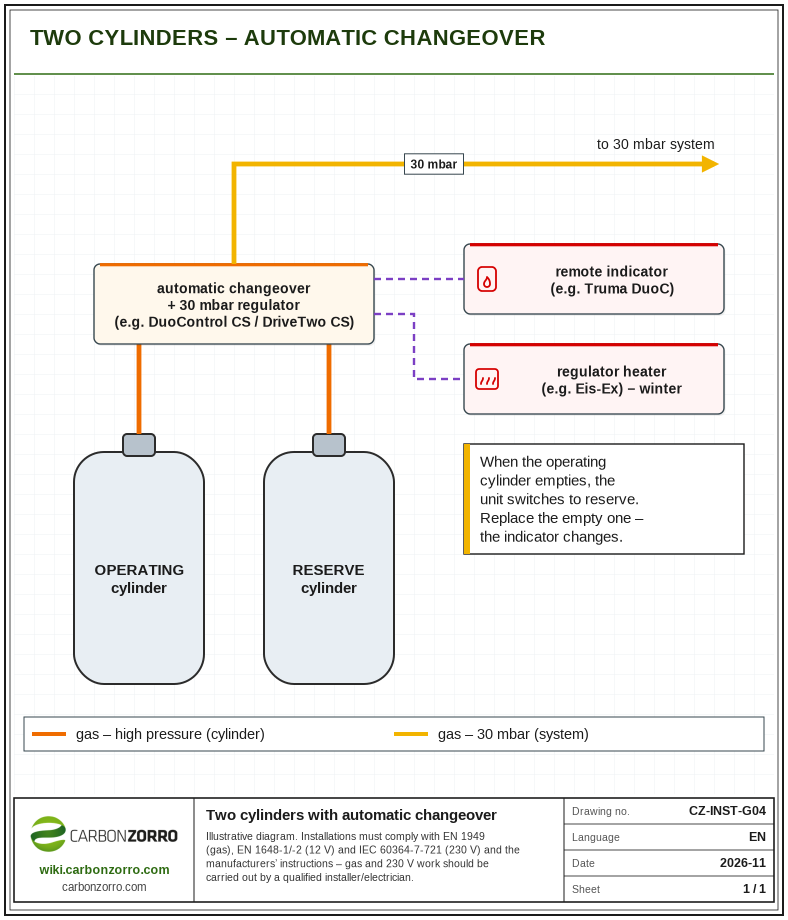
With two cylinders, an automatic changeover (e.g. Truma DuoControl CS, Cavagna 924N DUO, GOK Caramatic DriveTwo CS) draws from the service cylinder and switches to the reserve by itself when the first one runs empty. An indicator shows which cylinder needs replacing. For winter use, regulator heaters are available (e.g. Eis-Ex for the Caramatic TwoControl).
🛒 Products in the carbonzorro.com shop
- GOK Caramatic DriveTwo - horizontal
- GOK Caramatic DriveTwo - vertical
- GOK Reducer for underslung tanks 105° 30mbar Caramatic DriveOne CS
- Caramatic SafeDrive 30 mbar - Dla DE/AT/PL (Polish product page)
- Truma DuoC indicator with heater
- Truma adapter DuoControl CS poziomy (Polish product page)
- Fawo gas bottle holder, long version - 5 and 11 kg bottles, 120 cm strap
- Ilse gas bottle pull-out for 2 x 11 kg bottles for motorhome rear garages - full extension, automatic end lock, black steel
- Warm cover for a 11kg GasBank gas cylinder
- Regulator Heater Eis-Ex
Pipes, fittings and valves
- Pipe: usually 8 mm copper or precision steel, clipped along its run and kept away from heat sources and sharp edges.
- Fittings: compression type to EN ISO 8434-1, tightened to the maker's torque (e.g. the Truma table above). Check for leaks with spray to EN 14291 and a pressure test.
- Through floors and walls: in a grommet or sleeve, sealed.
- Isolating valves: a separate, labelled valve for each appliance, accessible without tools.
- External outlet: for a barbecue or stove outside the vehicle, with a valve and quick coupling.
- Leak test after every change: 150 mbar air pressure, maximum 5 mbar drop over 5 minutes after 5 minutes of stabilisation (EN 1949, 4.3). Details: leak testing.
🛒 Products in the carbonzorro.com shop
- Ø8mm Copper Pipe with PCV insulation - 1m
- Rura miedziana goła Ø 8 mm, ścianka do Ø 6 mm, na metry - instalacja gazowa i wodna (Polish product page)
- Domyślna nazwa
- MSR Precyzyjna rura stalowa 10mm ocynkowana 2m srebrna (Polish product page)
- Cutting Ring Screw Connection
- GOK Kąt przyłączeniowy Rp 1/2 x RVS 8 (Polish product page)
- GOK Klucz montażowy RVS 8x10
- GasBank obejma metalowo-gumowa P-clip do rurki miedzianej 8 mm (Polish product page)
- GOK Zawór szybkozamykający DSV RVS 8 mm - zawór odcinający gazu do kamperów i przyczep (Polish product page)
- Blok zaworów gazowych VK4, 4xinput 8mm (Polish product page)
- GOK Zawór odcinający SSV DL-MS RVS 8 (Polish product page)
- GOK Kulowy zawór gazowy RVS 8 20 bar (Polish product page)
- GOK Caramatic GasControl - elektrozawór gazowy, zdalny wyłącznik gazu 12/24 V, RVS 8 x RVS 8, 71 394 02 (Polish product page)
- GOK Manual gas valve RVS 8 x RVS 8 x RVS 8
- ABL gniazdo gazowe zewnętrzne z zamknięciem magnetycznym, białe - podłączenie grilla lub kuchenki do instalacji gazowej kampera (Polish product page)
- Carbon Zorro Zewnętrzne gniazdo gazu z szybkozłączem obrotowym RVS 8 mm - grill przy kamperze (Polish product page)
Gas appliances – consumption
| Appliance | Gas consumption (manufacturer data) |
|---|---|
| Truma Combi 4 | 160–335 g/h |
| Truma Combi 6 | up to 460 g/h |
| Truma Boiler (gas) | 120 g/h |
| Dometic RML 10.4 (fridge) | 380 g/24 h |
| CAN FC1346 hob | burners 1.1 and 2.0 kW (product data) |
How long a cylinder lasts: divide the cylinder contents in grams by the consumption in g/h. For an 11 kg cylinder and a Combi 4 at full output: 11,000 g ÷ 335 g/h ≈ 33 h. At low output (160 g/h) it is about 69 h. Real consumption depends on outside temperature, insulation and settings, so treat the result as an estimate.
🛒 Products in the carbonzorro.com shop
- Heater Truma S 3004
- Heater Truma S 5004
- CAN Kuchenka gazowa FC1346 2 palniki 1,1 / 2,0 kW z czarną szklaną pokrywą - zabudowa kamper (Polish product page)
- CAN Kuchenka gazowa FL1400 2 palniki ze zlewozmywakiem prawostronnym i szklaną pokrywą - kamper (Polish product page)
- Dometic LS 100 górna kratka wentylacyjna lodówki - zestaw z ramą i osłoną zimową, biała, 48 x 18 cm, do kampera i przyczepy (Polish product page)
- Dometic LS 200 biała - dolna kratka wentylacyjna lodówki do ściany kampera i przyczepy, zestaw z ramą i osłoną zimową (Polish product page)
Caravan vs motorhome
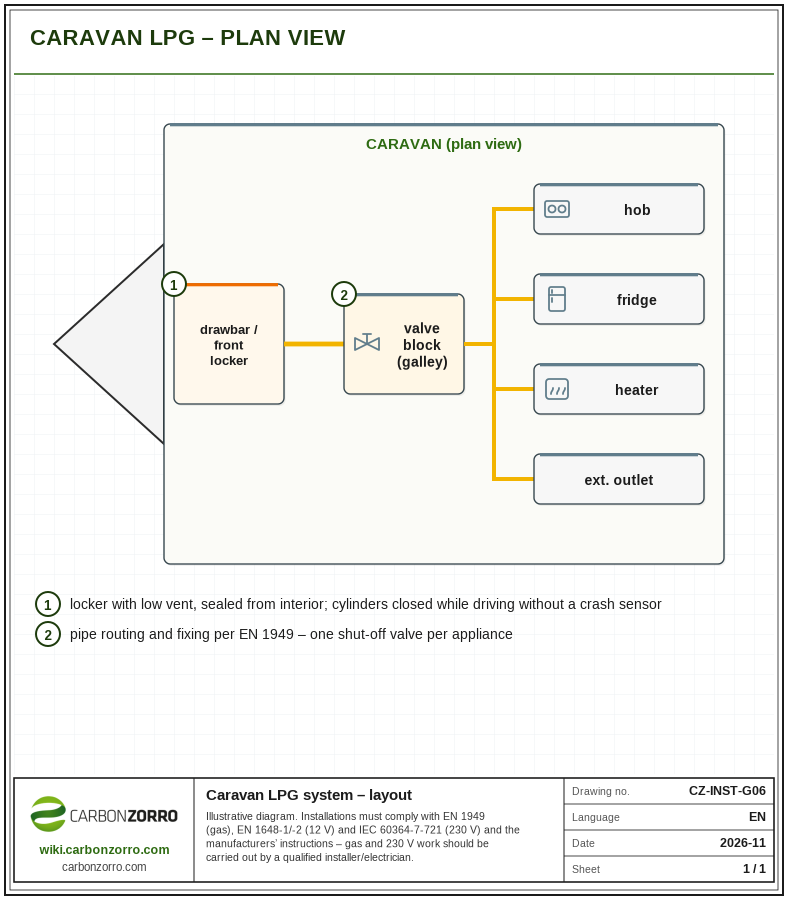
| Motorhome | Caravan | |
|---|---|---|
| Gas locker | usually at the rear or side, external access | usually on the A-frame (front locker) |
| Heating on the move | possible with a crash-sensor regulator | nobody rides in a caravan, so the cylinder is normally closed |
| Hose length (UK) | – | max 0.5 m (BS EN 1949) |
| Valves | one per appliance (EN 1949) | one per appliance (EN 1949) |
Exchange cylinders, refillable cylinders, fixed tanks
| Option | Pros | Limits |
|---|---|---|
| Steel exchange cylinder (11 kg) | easy to get at home | other countries use other threads and exchange schemes, so adapters are needed |
| Composite cylinder (e.g. Ragasco, FibreGas) | lighter, level visible | exchange scheme depends on the country |
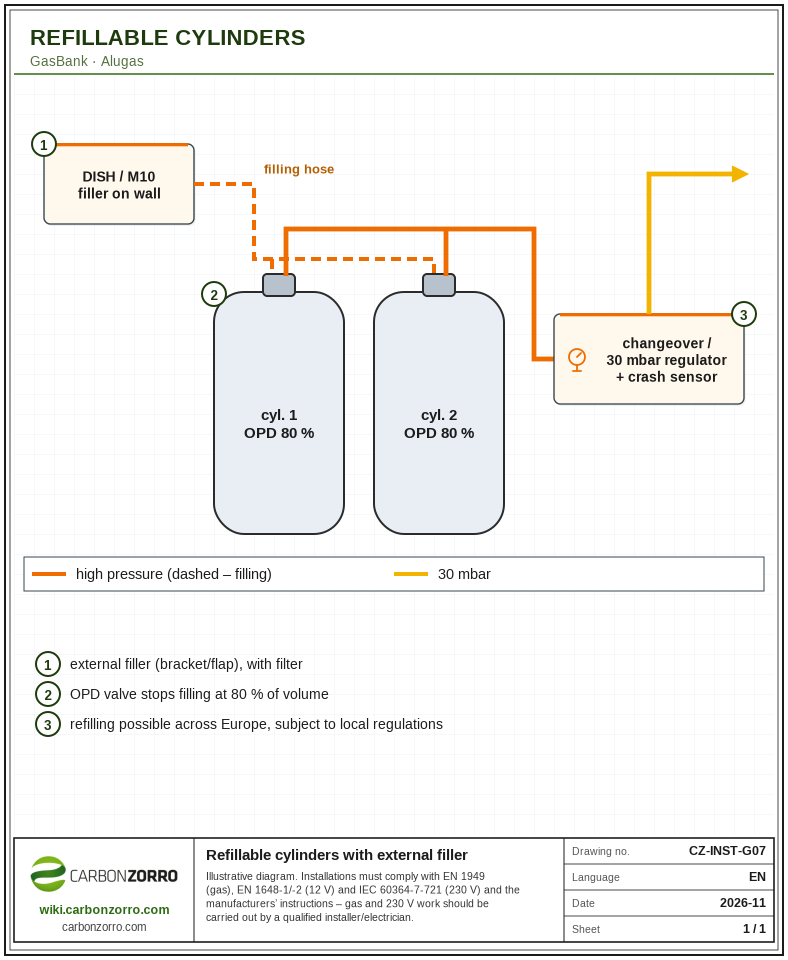
| Refillable cylinder (GasBank, Alugas) | filled at LPG stations; 80 % stop valve (OPD) | refilling possible across Europe, subject to local regulations |
| Fixed tank (R67) | large capacity, external filler | type approval, registration entry (e.g. Italy), tank expiry date |
Filling abroad: LPG pumps in Europe use different connectors, so a refillable cylinder needs an adapter set (e.g. DISH or M10 types – see the product descriptions).
🛒 Products in the carbonzorro.com shop
- GasBank MULTI 11 kg – composite LPG tank cylinder for self-filling, CE (2014/68/EU), multivalve, level gauge, 80% fill stop
- GasBank DUO 11 kg kompozytowa butla LPG z wejściem i wyjściem, OPD 80% - bez wskaźnika poziomu (Polish product page)
- GasBank LS DUO 11 kg light steel LPG cylinder 26.2 l with DUO valve and 80% OPD - 3/4 UNF inlet, G.12 KLF outlet
- Alugas TravelMate 27.2 l (11 kg) aluminium LPG cylinder - with multivalve and 80% fill stop, for motorhomes
- 2 x GasBank DUO + remote filling point DISH
- Gas cylinder Hexagon Ragasco 24.5 L propane/butane, complete, 0.0245 m³
- Remote DISH MULTI 2 BUTLE
- MULTI REMOTE DISH M10
- Bracket for Hidden and Dish Filling Point
- Zestaw końcówek do tankowania w całej Europie z zaworem zwrotnym DIN/M10 (do butli SINGLE) w etui (Polish product page)
- GasBank adapter tankowania LPG DISH na M10 z filtrem GB-F-05 - wymienny filtr ze spiekanego brązu (Polish product page)
- Euro-Set D Professional
- LPG TANK BLANKING PLUG 11 KG – W 21,8×1/14” – LEFT HAND THREAD
Gas system checklist
- [ ] cylinders upright, valve up, secured at top and bottom
- [ ] class 3 high-pressure hose, length allowed in your country, less than 10 years since manufacture
- [ ] gas filter before the regulator (mandatory with Truma CS regulators)
- [ ] 30 mbar regulator, vertical, outlet down; crash sensor if heating while driving
- [ ] separate valve for each appliance
- [ ] pipes clipped, grommets sealed
- [ ] leak test after every change, with a written record
- [ ] gas and CO detectors fitted and working
Sources
Every figure on this page comes from the sources below (standards, manufacturer manuals, regulations). Before installing, check the current edition of the standard and the manual of your specific device.
- EN 1949:2021 – standard preview (iTeh)
- SIST EN 1949:2022 – standard sample (tightness test, 4.3)
- Truma MonoControl CS – operating instructions
- Truma MonoControl CS – installation instructions
- Truma MonoControl CS – gas tank installation
- Truma – MonoControl CS product page
- Truma Combi (E) – operating instructions
- lpgwebshop – LPG installation in a recreational vehicle
- Liquid Gas UK – hoses and tubing information sheet
- promobil – Basiswissen Gas im Wohnmobil
- Truma Combi 4 – technical data
- Truma – dealer catalogue 2025
- Dometic RML 10.4 – technical data
- Polski Caravaning – Gaz na ulicach (PL)
- GasBank – FAQ
- ACI – Circolare MIT 19042/2018 (serbatoi GPL autocaravan)
If you spot an inaccuracy, please report it to info@carbonzorro.com.
The content of this Knowledge base is for general information and illustration only. It is not technical or legal advice and does not replace standards, regulations, manufacturers’ instructions or the work of a qualified installer. Carbon Zorro Sp. z o.o. makes every effort to keep the information accurate and up to date, but does not guarantee that it is complete and accepts no liability for any consequences of its use.
Questions & comments