
Charging the leisure battery: alternator, DC-DC booster, solar, 230 V charger, 13-pin socket
⚠️ Safety: 230 V wiring must be installed and tested by a qualified electrician (IEC/HD 60364-7-721). At 12 V the main hazard is fire from a short circuit – fuse every (+) cable at its source. Disconnect the batteries before working.
The leisure battery is charged from three sources: the alternator while driving (relay/separator or a DC-DC booster), solar panels via an MPPT controller, and 230 V mains via a charger or an inverter-charger. Every source must use a charge profile that matches the battery chemistry (voltages: 12 V batteries).
Charging sources compared
| Source | When it works | Pros | Limits |
|---|---|---|---|
| Relay / separator (e.g. Cyrix, D+ relay) | engine running | simple, cheap | no charge profile; with "smart" alternators (Euro 6) the voltage may be too low |
| DC-DC booster (e.g. Victron Orion XS, Votronic VCC, Büttner MT) | engine running | full charge profile (LiFePO4 too), works with Euro 6 | needs heavier cables and fuses |
| MPPT controller + panels | daylight | free energy when parked | depends on weather and season |
| 230 V charger | on hook-up | full charge, float | only with mains power |
| 13-pin socket (caravan) | tow car engine running | charging on the move | usually just a trickle charge (Humbaur) |
DC-DC booster (alternator charging)
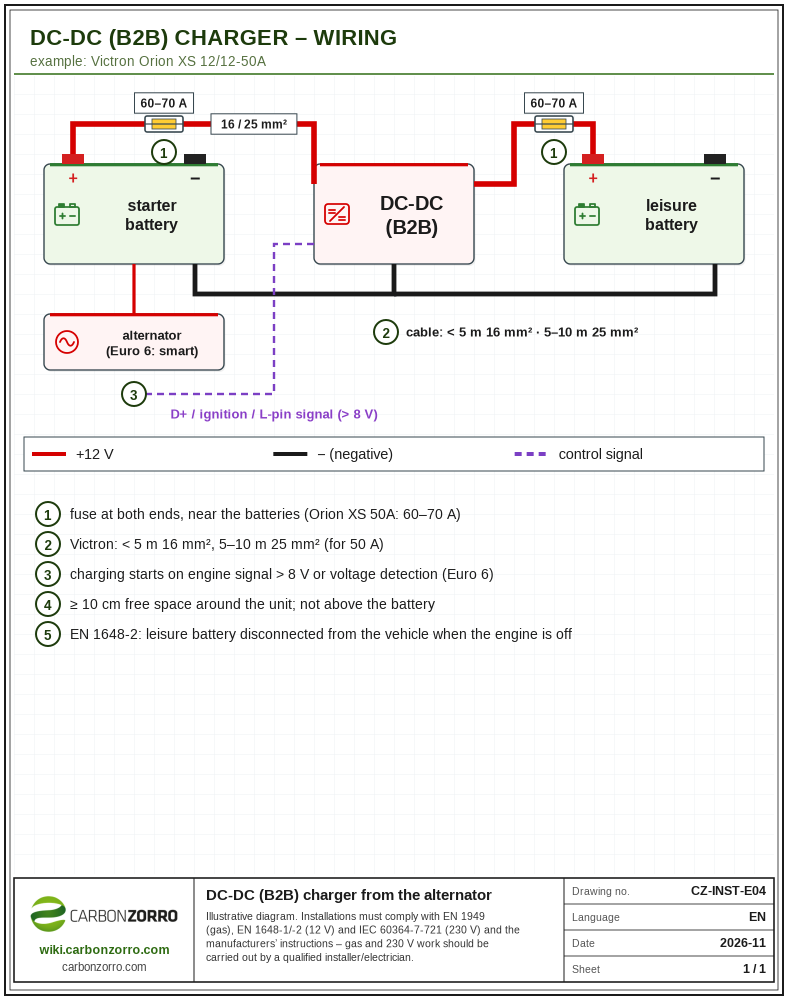
From the Victron Orion XS 12/12-50A manual:
| Parameter | Value (Victron) |
|---|---|
| Fuse on input and output | 60–70 A |
| Cable size, length < 5 m | 16 mm² |
| Cable size, length 5–10 m | 25 mm² |
| Clearance around the unit | 10 cm; not above the battery |
| Terminal torques | 5.6 / 4.5 / 2.8 Nm (per terminal type in the manual) |
| "Engine running" signal | L input > 8 V or voltage detection (Euro 6 too) |
Votronic VCC 1212-30: D+ input 8–17 V, draw < 1 mA, signal wire fused at 1 A; Votronic requires the D+ signal in Euro 6 vehicles.
Installation sequence (principle):
- Pick a ventilated spot close to the leisure battery.
- Run the input cable (from the starter battery) and the output cable, fused at both batteries.
- Connect the negative with a heavy cable to a common earth point (per the manual).
- Connect the ignition/D+ signal (fused per the manual).
- Set the charge profile (e.g. LiFePO4) and maximum current.
- Check operation with the engine running.
🛒 Products in the carbonzorro.com shop
- Battery Control Booster MT
- charging booster MT LB 12V
- Carbest BatteryBooster 12 V / 30 A - charging booster for 45-280 Ah batteries
- Carbest PowerPeak Booster - charging booster with MPPT solar controller up to 400 W, 205 x 105 x 52 mm
- Dometic ładowarka akumulatora DC/DC NDS POWERSERVICE PLUS30 Black (Polish product page)
- Dometic ładowarka akumulatora AC-DC/DC-DC NDS POWERSERVICE Gold 25-M 12 V Black (Polish product page)
- Cyrix-ct 12/24V-230A intelligent combiner
- CBE cut-off relay - 70 A, for automatic separation of 2 batteries
- Carbest SVB13 12 V 30 A split charge relay - D+ simulator, 2 outputs, reverse charging
Solar panels and MPPT controller
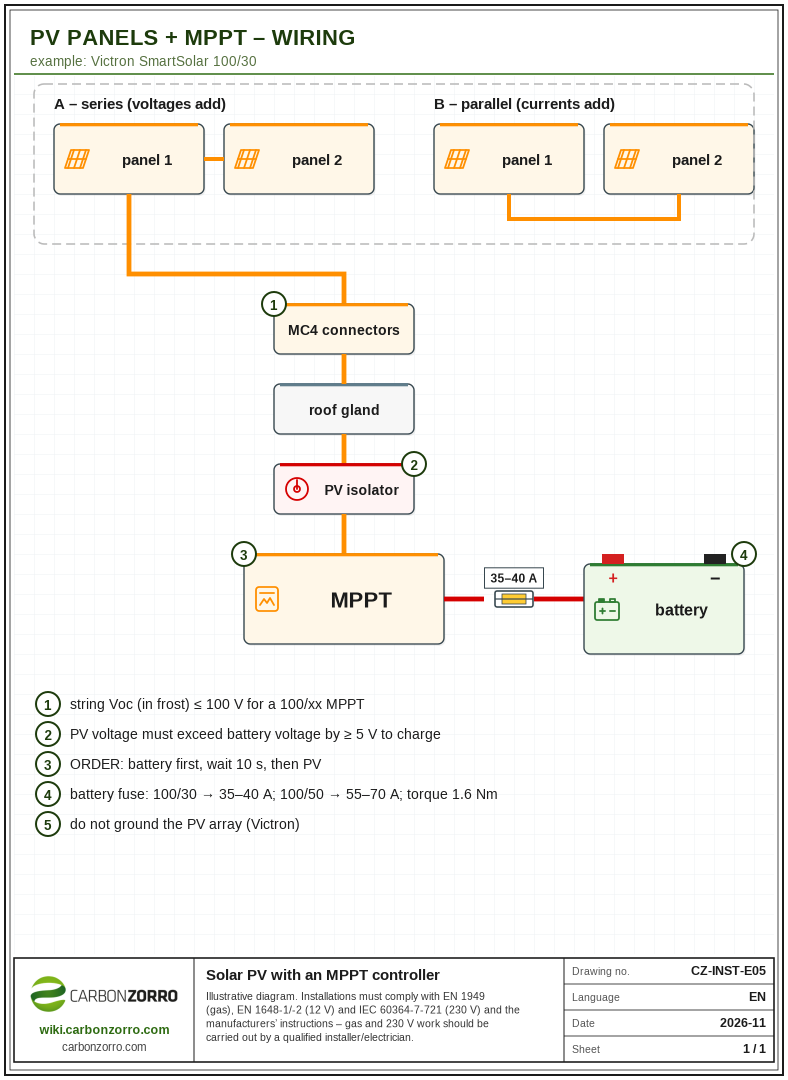
From the Victron SmartSolar MPPT 100/30 and 100/50 manual:
| Rule / parameter | Value (Victron) |
|---|---|
| Connection order | battery first, wait 10 s, then the panels |
| Battery fuse 100/30 | 35–40 A |
| Battery fuse 100/50 | 55–70 A |
| PV open-circuit voltage Voc | ≤ 100 V (also at low temperature) |
| PV voltage to start charging | ≥ battery voltage + 5 V |
| Terminal torque | 1.6 Nm |
| PV array earthing | the PV array must not be earthed |
| Cable strands | ≤ 0.4 mm (flexible cable) |
Roof mounting: bonded brackets (spoilers, corner mounts), a sealed roof cable entry, and solar cable with MC4 plugs crimped with the proper tool. Follow the bracket/adhesive maker's instructions for adhesive and surface preparation.
Series or parallel: in series the voltage adds up (watch the controller's Voc limit), in parallel the current adds up (heavier cables). With partial shading, parallel panels usually lose less. Decide using the panel and controller datasheets.
🛒 Products in the carbonzorro.com shop
- Caratec CES220 - TOPCon solar panel 220 Wp for motorhomes and caravans, 4 m cable
- Carbest PowerPanel SFX135 półelastyczny moduł solarny 135 W - ogniwa SunPower, ETFE, przewód 6 m (Polish product page)
- Carbest Powerpanel Flex flexible solar module 150 W - 540 x 1360 mm, 24.4% efficiency, 8 m cable
- Carbest składany panel solarny HC130 130 W - powierzchnia ETFE, rama aluminiowa, nóżki (Polish product page)
- CBE PRM400 - MPPT regulator 400 W, 12 V, 28 A, Bluetooth, 150 x 110 x 48 mm
- Caratec CES260MPPT - MPPT solar controller 20 A, 12/24 V, Bluetooth
- Caratec CES550MPPT - MPPT solar controller 40 A, 12/24 V, Bluetooth
- 30A EPEVER XTRA MPPT solar charge controller 12/24V
- All-In-One Solar System PowerPack Classic, 440 Wh
- All-In-One Solar System FLAT AIR NL FA 130 M, 130 Wp
- Solar Panel Mounting Brackets (7pcs) WHITE For RV Boat Caravan
- NLS Przelotka dachowa PUR do panela fotowoltaicznego - złącza MC4, kabel 0,5 m (Polish product page)
- LILIE solar cable with MC4 plugs for campere modules - red and black, 10 m
- NLS NL99004 MC4 solar connector tool set - crimping pliers, pair of spanners, 10 pairs of connectors with pins, bag
- Spoiler Profile
230 V charger
- Choose the profile for the chemistry (AGM, gel, LiFePO4).
- Charge current: Victron recommends 0.5 C for LiFePO4; for AGM use the datasheet figure.
- Feed the charger from an RCD-protected circuit – see 230 V system.
- Fuse the 12 V output at the battery.
🛒 Products in the carbonzorro.com shop
13-pin socket (ISO 11446) – caravans
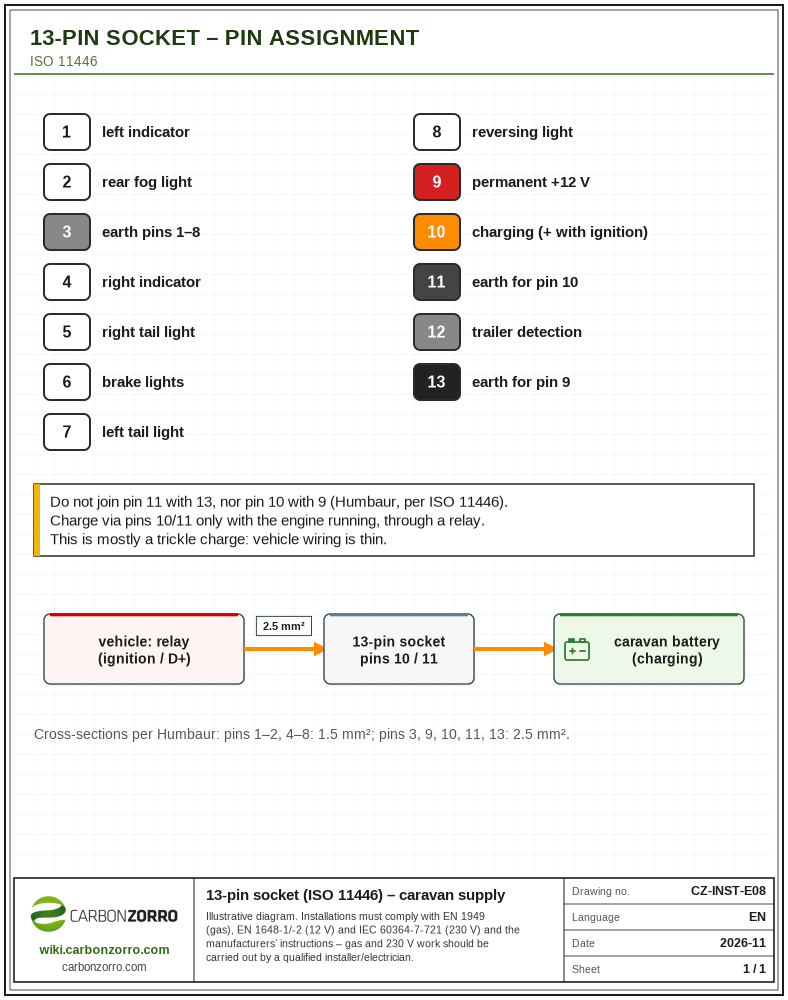
| Pin | Function | Cable size (Humbaur) |
|---|---|---|
| 1 | left indicator | – |
| 2 | rear fog light | – |
| 3 | earth for circuits 1–8 | 2.5 mm² |
| 4 | right indicator | – |
| 5 | right tail light | – |
| 6 | brake lights | – |
| 7 | left tail light | – |
| 8 | reversing light | – |
| 9 | permanent supply (+) | 2.5 mm² |
| 10 | charging supply (+) | 2.5 mm² |
| 11 | earth for pin 10 | – |
| 12 | trailer detection | – |
| 13 | earth for pin 9 | – |
Humbaur's rules: do not join pins 11 and 13, and never bridge pin 10 to pin 9. Pin 10 should be live only with the engine running (via a relay). Charging through the socket is usually only a trickle charge.
Charging troubleshooting
| Symptom | Cause | Fix |
|---|---|---|
| Booster will not start | no D+/L signal, Euro 6 | check the signal and detection settings |
| MPPT not charging in the morning | PV voltage < battery + 5 V | normal in low light |
| MPPT fault after installation | panels connected before the battery | order: battery → 10 s → panels |
| Caravan not charging while towing | pin 10 without relay / thin cable | relay in the car, 2.5 mm² cable |
| LiFePO4 not charging in winter | temperature < +5 °C | warm the battery |
Charging checklist
- [ ] every source uses the right profile for the chemistry
- [ ] fuses at both ends of the booster supply cables
- [ ] cable sizes per manual (e.g. Orion XS: 16/25 mm²)
- [ ] MPPT: battery first, then panels
- [ ] panel Voc below the controller limit
- [ ] roof entry sealed
Sources
Every figure on this page comes from the sources below (standards, manufacturer manuals, regulations). Before installing, check the current edition of the standard and the manual of your specific device.
- Victron Orion XS 12/12-50A – installation
- Votronic VCC 1212-30 – manual
- Victron SmartSolar MPPT 100/30 and 100/50 – manual
- Victron Lithium Battery Smart – operation
- Humbaur – pin assignment 7/13-pin (ISO 11446)
- EN 1648-2:2018 – standard preview
If you spot an inaccuracy, please report it to info@carbonzorro.com.
The content of this Knowledge base is for general information and illustration only. It is not technical or legal advice and does not replace standards, regulations, manufacturers’ instructions or the work of a qualified installer. Carbon Zorro Sp. z o.o. makes every effort to keep the information accurate and up to date, but does not guarantee that it is complete and accepts no liability for any consequences of its use.
Questions & comments