
Grey and black water in a motorhome: tank, valves, traps and cassette toilet
⚠️ Note: the water system connects to a gas boiler and to 12/230 V. Leave work on the gas boiler and on 230 V to a specialist. Use only parts approved for drinking water.
Grey water is what drains from the sink, washbasin and shower. Black water is toilet waste – in most motorhomes and caravans this means the cassette of a chemical toilet (e.g. Thetford, Dometic). Both must only be emptied at designated disposal points on campsites and service stations.
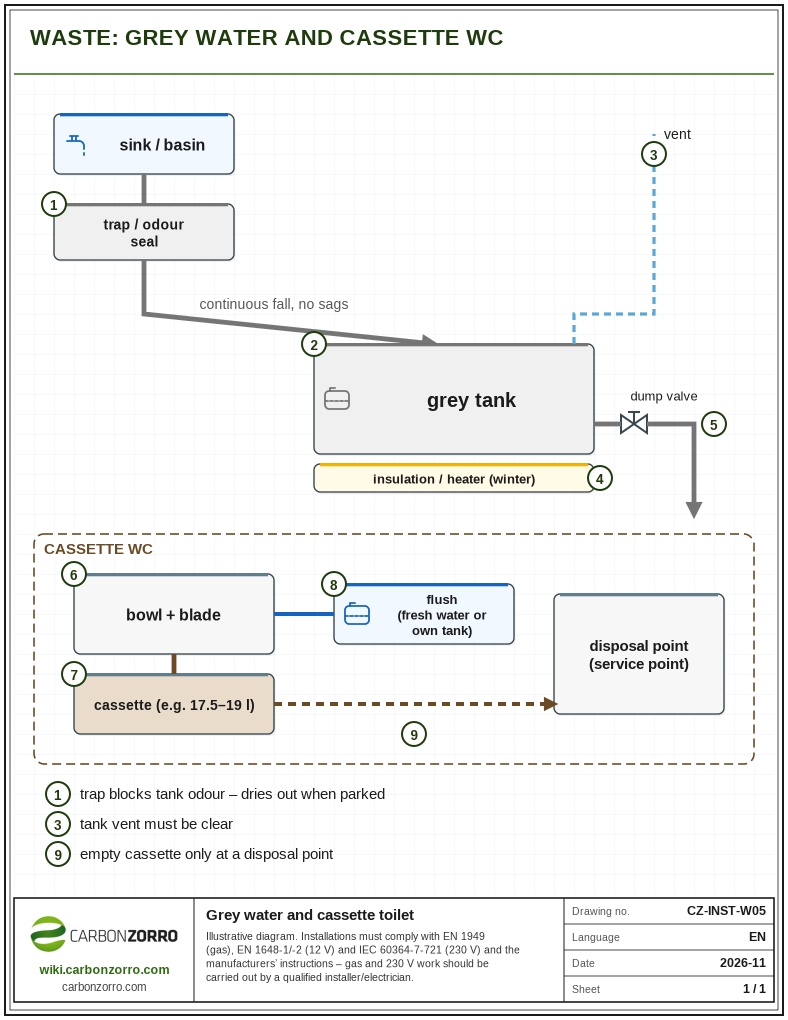
Parts of the waste system
| Part | Purpose | Watch out for |
|---|---|---|
| Trap (water seal) | keeps tank odours out | shallow traps hold little water and are shaken empty while driving or dry out when parked (promobil) |
| Waste pipes | gravity drain to the tank | constant fall, no sags where water stands |
| Grey water tank | storage | underfloor (freezes) or in a double floor (heated) |
| Drain valve (gate) | emptying | never force it when frozen |
| Tank vent | pressure equalisation | without it water drains slowly and smells come up through the traps |
| Level gauge | fill monitoring | probes foul with starch and grease deposits |
| Toilet cassette | black water | capacity per manufacturer, e.g. Thetford C220: 18 l, C260: 17.5 l |
🛒 Products in the carbonzorro.com shop
- Underfloor waste water tank 75 l Aplast 700000211 - Fiat Ducato, Citroën Jumper, Peugeot Boxer, 94.0 x 75.0 x 23.7 cm
- Underfloor waste water tank 100 l Aplast 700000290 - Fiat Ducato, Citroën Jumper, Peugeot Boxer, 98.2 x 85.0 x 22.9 cm
- Underfloor waste water tank 95 l Aplast 700000271 - Mercedes-Benz Sprinter, 107.0 x 70.0 x 23.8 cm
- Przenośny zbiornik na ścieki Fiamma Roll Tank 23 W - 22,5 litra (Polish product page)
- FAP Zawór spustowy wody szarej 1 1/2 (Polish product page)
- FAP zawór spustowy 3 cale żeński z prętem sterującym 60 cm - kompletny, z korkiem bagnetowym (Polish product page)
- Odour Trap
- DOMETIC SIPHON WITH ANGLED WASTE FITTING, Ø 25 MM
- CAN odpływ kątowy do zlewozmywaka ø 55 mm z korkiem - przyłącze węża 20/25 mm (Polish product page)
Fitting a grey water tank – sequence
- Location: as low as possible, with access to the drain valve and room to position over a drain grid. Check payload and weight distribution (a full tank weighs its capacity in kg).
- Mounting: the frame or straps specified by the tank maker – under braking a full tank exerts large forces.
- Inlets: at the top or side, above the maximum water level. Every drain has its own trap.
- Vent: at the highest point of the tank, routed outside.
- Drain: valve at the lowest point, easy to reach. For winter use add insulation and a heater (e.g. the kit for the Aplast 75 l tank).
- Leak test: fill the tank through the sink, check every joint, then empty.
Match pipes and fittings to the tank and outlet spigot diameters; the usual system sizes are listed in each product description.
Where drain smells come from
According to promobil, smells inside the vehicle usually appear when the trap loses its water (shallow trap, vibration on the road, drying out when parked) and biofilm builds up in the tank – and that smell is hard to get rid of.
What not to pour down the sink (promobil):
- pasta water – starch settles on tank walls and in hoses,
- milk and dairy – rapidly breed strong-smelling bacteria,
- coffee and tea grounds – settle and block the drain valve,
- egg-boiling water – sulphur compounds smell rotten,
- soup and sauce leftovers – fat plus organic residue feeds biofilm,
- juices with pulp – ferment in the tank.
Prevention:
- empty the tank often, not just when full,
- rinse it with clean water,
- use grey-tank treatments as directed,
- top up the traps before driving or fit a non-return / waterless trap.
🛒 Products in the carbonzorro.com shop
- certisil combina
- DEXDA® Clean aktywna dezynfekcja i usuwanie biofilmu (Polish product page)
Cassette toilet
- Cassette: removed from outside through a service door; capacity by model (Thetford C220: 18 l; C260: 17.5 l).
- Flush water: from a separate toilet tank or from the main fresh tank (model-dependent).
- Level indicator: shows when to empty.
- Emptying: only at a chemical toilet disposal point (CDP), with the spout rotated and the cassette vent button pressed so it does not splash.
- Fluids: a breakdown/odour fluid in the cassette, a rinse fluid in the flush tank – dose per the label.
- Seals: after emptying, care for the blade seal with the product the manufacturer recommends.
🛒 Products in the carbonzorro.com shop
- Dometic toaleta kasetowa CTS 4110 19 l z kółkami i miską ceramiczną (Polish product page)
- Cassette Toilet CT 4000
- Thetford waste tank, grey - C220
- Thetford seal for waste tank - C2, C3, C4
- Toaleta kempingowa Fiamma Bi-Pot 34 (Polish product page)
- Dometic GreenCare Tabs - waste holding tank tabs, 16 pcs in a resealable pouch
Winter
- The underfloor grey tank freezes first – fit insulation and a heater, or leave the valve open with a bucket underneath.
- For winter lay-up empty the grey tank and the cassette and leave the drain valve open (promobil – see hot water and winterising).
- Flush tank: drain it as described in the toilet manual.
🛒 Products in the carbonzorro.com shop
Troubleshooting
| Symptom | Cause | Fix |
|---|---|---|
| Smell from the sink | trap empty, biofilm in tank | top up, clean and rinse tank, fit a sealed trap |
| Slow, gurgling drain | vent missing or blocked, sag in pipe | clear the vent, correct the fall |
| Drain valve jammed | grounds, deposits, ice | flush; thaw ice, do not force |
| Level gauge wrong | probes fouled (starch, grease) | clean tank and probes |
| Cassette leaks at the blade | seal dry or worn | treat or replace the seal |
Checklist
- [ ] every outlet has a trap
- [ ] pipes have a constant fall, no sags
- [ ] tank vented and securely mounted
- [ ] drain valve accessible and frost-protected
- [ ] empty only at designated points
- [ ] cassette seals cared for
Sources
Every figure on this page comes from the sources below (standards, manufacturer manuals, regulations). Before installing, check the current edition of the standard and the manual of your specific device.
- promobil – Wasseranlage entleeren / Grauwassertank
- camperwissen – Grauwassertank im Wohnmobil
- Thetford – cassette toilets overview 2025
- Truma – draining the boiler (FAQ)
- DVFG – G 607-Prüfung für Freizeitfahrzeuge
If you spot an inaccuracy, please report it to info@carbonzorro.com.
The content of this Knowledge base is for general information and illustration only. It is not technical or legal advice and does not replace standards, regulations, manufacturers’ instructions or the work of a qualified installer. Carbon Zorro Sp. z o.o. makes every effort to keep the information accurate and up to date, but does not guarantee that it is complete and accepts no liability for any consequences of its use.
Questions & comments