
230 V mains system in motorhomes and caravans: hook-up, RCD, circuits, inverter
⚠️ Safety: 230 V wiring must be installed and tested by a qualified electrician (IEC/HD 60364-7-721). At 12 V the main hazard is fire from a short circuit – fuse every (+) cable at its source. Disconnect the batteries before working.
Mains wiring in leisure vehicles is covered by IEC 60364-7-721: in the UK BS 7671 section 721, in Poland PN-HD 60364-7-721:2019-05, in Germany DIN VDE 0100-721:2019-10. It applies to installations up to 230 V single-phase / 400 V three-phase and DC circuits up to 48 V. The principles of the standard are set out below. The work itself and the testing are for a qualified electrician.
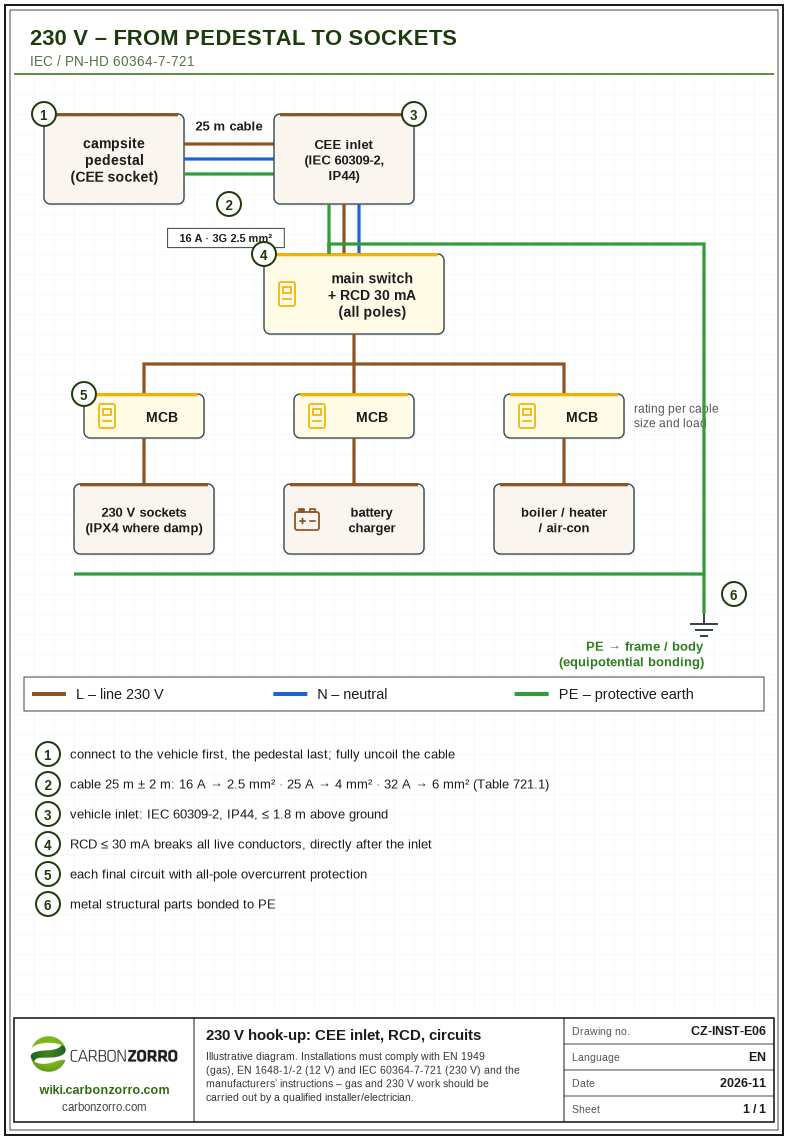
IEC 60364-7-721 requirements – overview
| Requirement | Content | Source |
|---|---|---|
| Residual current device (RCD) | ≤ 30 mA, disconnects all live conductors; the inlet goes directly to the RCD | IEC 60364-7-721 |
| Main isolating switch | disconnects all poles; notice with instructions | IEC 60364-7-721 |
| Final circuit protection | overcurrent protection on all poles | IEC 60364-7-721 |
| Cables | class 5 flexible, or class 2 (≥ 7 strands) in conduit, or sheathed flexible cable; flame-retardant (IEC 60332-1-2) | IEC 60364-7-721 |
| Minimum cross-section | 1.5 mm² | IEC 60364-7-721 |
| Cable supports | every 0.4 m vertically, every 0.25 m horizontally | IEC 60364-7-721 |
| Joints | only inside enclosures | IEC 60364-7-721 |
| Protective conductor | in the same cable as the live conductors | IEC 60364-7-721 |
| Bonding | metal frame/structure bonded to the main earthing terminal | IEC 60364-7-721 |
| Inlet | IEC 60309-2 (CEE), ≤ 1.8 m above ground, IP44, accessible | IEC 60364-7-721 |
| Socket-outlets | with earth contact; IPX4 where exposed to moisture | IEC 60364-7-721 |
| Gas locker | no electrical equipment (except extra-low-voltage gas controls) | IEC 60364-7-721, 721.528.3.1 |
| Connecting cable | 25 m ±2 m | IEC 60364-7-721 |
Hook-up cable cross-section (Table 721.1)
| Rated current | Cross-section (25 m cable) |
|---|---|
| 16 A | 2.5 mm² |
| 25 A | 4 mm² |
| 32 A | 6 mm² |
| 63 A | 16 mm² |
| 100 A | 35 mm² |
The hook-up cable is a rubber-sheathed flexible such as H05RN-F (IET) or H07RN-F (e.g. the AS Schwabe 3G2.5 mm² extension). According to the Camping and Caravanning Club, site hook-ups usually supply 10 or 16 A. Always fully uncoil the cable from the reel, because a coiled cable heats up, and carry your own RCD in the vehicle.
🛒 Products in the carbonzorro.com shop
- AS Schwabe przedłużacz CEE 25 m z kontrolką powerlight, wtyczka i gniazdo CEE 16 A, 230 V, IP44, H07RN-F 3G2,5 mm² - kabel do kampera i przyczepy (Polish product page)
- ABL CEE Plug for Cable Mounting 230 V, 16 A, 3-pole, IP44, blue - Build a Supply Cable for Motorhome and Caravan
- ABL gniazdo CEE na przewód 230 V, 16 A, 3-biegunowe, IP44, niebieskie - przedłużacz zasilający do kampera i przyczepy (Polish product page)
- AS Schwabe kabel adapterowy z wtyczki Schuko na gniazdo CEE 1,5 m, 16 A, 230 V, IP44, H07RN-F 3G2,5 mm², kontrolka LED - zasilanie kampera z gniazdka (Polish product page)
- ABL Multifunction Exterior Socket Schuko 230 V, 12 V and 2 x SAT, white, IP44 - Power and TV Outside the Motorhome
- AS Schwabe wyłącznik różnicowo-nadprądowy 2w1 w obudowie, 16 A, C, 30 mA, typ A, 2-biegunowy (1+N), 230 V - do instalacji kampera i przyczepy (Polish product page)
- AS Schwabe wyłącznik różnicowoprądowy w obudowie, 25 A, 30 mA, typ A, 2-biegunowy, 230 V - ochrona przeciwporażeniowa w kamperze i przyczepie (Polish product page)
- CBE residual-current circuit breaker - 30 mA, with 13 A MCB, surface housing, grey
- CBE miniature circuit breaker - 13 A, 2-pole, without RCD, surface housing, grey
Building the 230 V system – from the inlet onwards
- CEE inlet (IEC 60309-2) on the outside of the vehicle, IP44, ≤ 1.8 m above ground.
- Cable to the consumer unit: as short as possible and protected.
- RCD ≤ 30 mA (or RCBO) as the first device after the inlet.
- All-pole main switch (often combined with the RCD/RCBO).
- Circuit breakers for the final circuits, rated by the electrician to suit cable and load.
- Circuits: sockets, charger, 230 V water-heater element, fridge, air conditioning.
- Protective conductor to every socket and class I appliance; bonding of the structure.
- Testing (PE continuity, insulation resistance, RCD test) and a certificate, done by the electrician.
🛒 Products in the carbonzorro.com shop
Inverter and inverter-charger
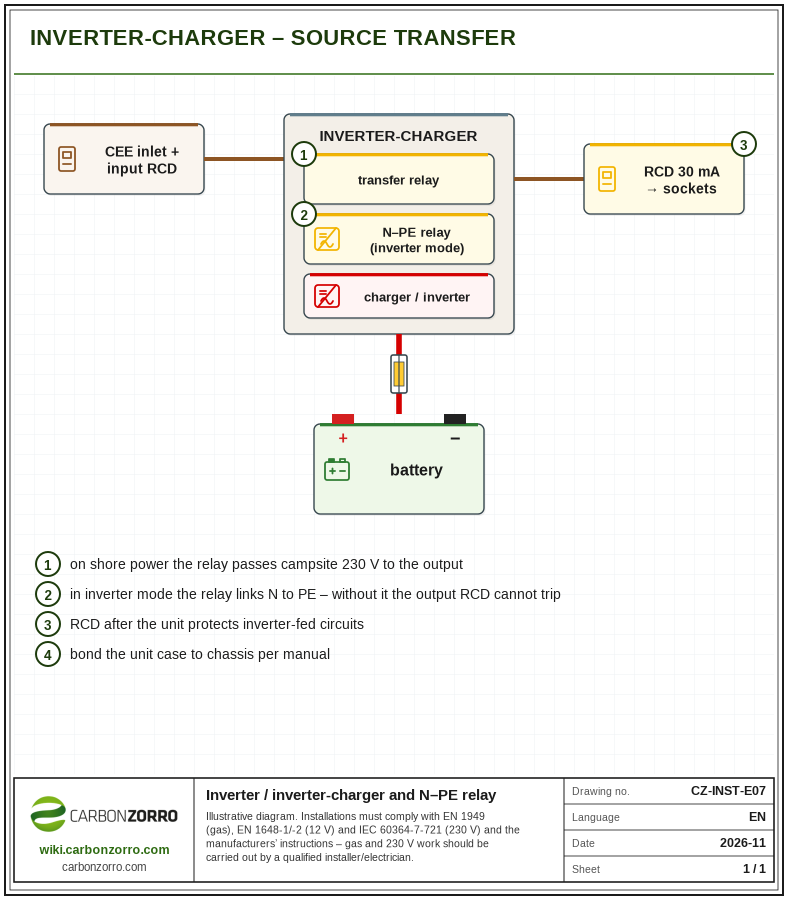
An inverter turns 12 V battery power into 230 V. The rules:
- Choose the 12 V cable size and fuse from the inverter manual. Currents are high: I = P ÷ U, so 1000 W ÷ 12 V ≈ 83 A before conversion losses. The manufacturer gives the exact current and fuse.
- An inverter-charger with a transfer switch (e.g. Victron MultiPlus) switches between shore power and inverter. In inverter mode it must link N to PE (ground relay), or the RCD will not work (Victron, Wiring Unlimited).
- Never connect an inverter output to the shore inlet without a transfer device.
- Bond the vehicle structure to earth/PE as the manual describes.
🛒 Products in the carbonzorro.com shop
- Inwerter Phoenix 12/800 230V VE.Direct IEC Victron bez Bluetooth (Polish product page)
- Carbest PowerWave 1000 W przetwornica sinusoidalna - z automatycznym priorytetem sieci 230 V (Polish product page)
- Dometic falownik sinusoidalny SinePower DPSI 2012RCD 2000 W 12 V (Polish product page)
- Inwerter ładowarka 3600W RCD kamper off-grid ten Haaft (Polish product page)
- BullTron Inverter-Charger 2000W C2000-12-NVFILS Outdoor IP20
Caravan vs motorhome
The IEC 60364-7-721 requirements are the same for both. In a caravan the inlet is usually on the side of the body, and the site hook-up (10/16 A) limits the load. Motorhomes more often get an inverter and larger charging systems.
230 V troubleshooting
| Symptom | Cause | What to do |
|---|---|---|
| RCD trips on connection | leakage in an appliance, damp | disconnect circuits one at a time, call an electrician |
| Bollard trips | too much load (e.g. kettle + heater) | keep the load within the hook-up rating |
| RCD ineffective on inverter | no N-PE link in inverter mode | check inverter settings / ground relay |
| Cable gets hot | left coiled on the reel | uncoil completely |
230 V checklist
- [ ] CEE inlet IP44, ≤ 1.8 m
- [ ] RCD ≤ 30 mA as the first device
- [ ] all-pole main switch + notice
- [ ] all-pole circuit protection
- [ ] cables at least 1.5 mm², supported every 0.4/0.25 m
- [ ] no 230 V equipment in the gas locker
- [ ] electrician's test certificate
Sources
Every figure on this page comes from the sources below (standards, manufacturer manuals, regulations). Before installing, check the current edition of the standard and the manual of your specific device.
- IEC 60364-7-721:2017 – standard sample
- IET – Electrical installations in caravans and motor caravans
- Camping and Caravanning Club – electricity for campers
- Victron – Wiring Unlimited: ground, earth and electrical safety
- PN-HD 60364-7-721:2019-05 (PKN) oraz DIN VDE 0100-721:2019-10
- elektro.info – przyczepy kempingowe i pojazdy z przestrzenią mieszkalną (PL)
If you spot an inaccuracy, please report it to info@carbonzorro.com.
The content of this Knowledge base is for general information and illustration only. It is not technical or legal advice and does not replace standards, regulations, manufacturers’ instructions or the work of a qualified installer. Carbon Zorro Sp. z o.o. makes every effort to keep the information accurate and up to date, but does not guarantee that it is complete and accepts no liability for any consequences of its use.
Questions & comments